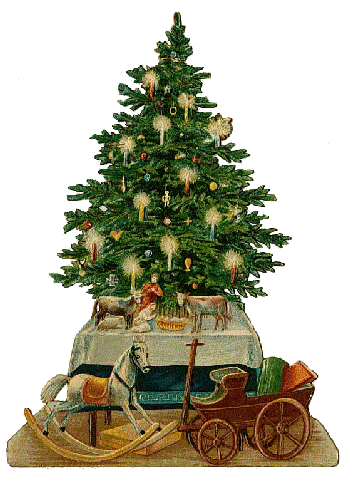
The History of the Christmas Tree
The Christian symbol color of Advent and Christmas - both in the Advent wreath and the Christmas tree ornaments are green and red
Green symbolizes not only the hope of maintaining life in the dark winter, but also that the fidelity.
The life force that was in winter-green plants, has often been interpreted as a healing power.
It was believed to bring health into the house when it is adorned with green. Spruce, fir, pine, yew, boxwood, holly, holly, gorse, juniper, ivy, cranberries, rosemary and boxwood were granted special powers
It was believed to bring health into the house when it is adorned with green. Spruce, fir, pine, yew, boxwood, holly, holly, gorse, juniper, ivy, cranberries, rosemary and boxwood were granted special powers.
Red recalls the blood of Christ, which he has shed so that the world might be saved. The color combination of green and red symbolizes Christians are supernatural hope.
The colors dominate the Christmas tree, the table decorations (. For example) with the poinsettia, Christmas and packing of gifts. To celebrate the winter solstice green branches were beaten and charms, as well as protection for the evocation of the summer. In all cultures and religions of the evergreen tree, home of the gods and thus have been signs of life.
The custom to make green pine branches into the house, is attested already in 1494 in the "Ship of Fools, Brant.
From the year 1535 is recorded that were sold in Strasbourg little yew, holly and beech trees, which were hung up without candles in their rooms with the sharp downward.
1605 it should already be decorated with apples, have given but still candleless Christmas tree in Strasbourg, which was built as a "Gabenbaum" or "Bescherbaum.
The "Christmas tree" has its origins in medieval Christmas pageant at church. Before the actual nativity play paradise game was held, in which it was shown, as in Adam and Eve, sin entered the world of which we were liberated by Christ's crucifixion. For this game belonged to an evergreen tree as a "paradise tree" (also Adam Baum), which was decorated with apples.Over the years, the Paradise tree became more handsome:
(gold), nuts, and sweets Festgebäck replaced or supplemented by little the apples to make clear the "paradise" function of the tree for the faithful.
In "Silver Paper" and "gold paper" wrapped fruit of this tree so they became the templates for Christmas ornaments and Christmas decorations. In the 16-17. Century appears on the Paradise tree outside the church: in Gemeinschaftsfeiern of guilds and brotherhoods. He thus broke from the nativity scene was a symbol of the Advent and Christmas season.
The first kerzengeschmückte Tannenbaum, finally has been handed in Silesia in 1611 issued: Castle of the Duchess Dorothea Sybille of Silesia.
In the 18th Tannenbaum was the century of increasing frequency, as reported Lieselotte von der Pfalz in 1708 from a book tree with candles.The lights appear first trees in the home and evangelical families - as a confessional Gegensymbol the (Catholic) Nativity. The Prussian king Frederick the Great (1740 - 1786) reported in 1755 by pine trees, where the parents' golden potato "(= hang) potatoes," to the children vorzuspiegeln a form of paradise apples ".
Johann Wolfgang von Goethe met the Christmas tree in Strasbourg in 1770 and known as one of the earliest literary references in his "Werther" from 1774 found.
Although the Christmas tree already testified in Berlin and Hamburg before 1800 is, in general use, he was only in the first half of the 19th Century.
That the disclosure was made progress relatively slow, of course, had much to do with the fact that it had rejected the church because of its magical origin "at first.
In Berlin, the first Christmas tree appeared around 1780.
For the year 1813, the first Weihnachtsbaüme from Vienna and Graz are reported. General has distributed the first Christmas in Austria, had been celebrated since Henrietta of Nassau-Weilburg, the wife of the Archduke Charles, in 1816 the celebration of Christmas with a Christmas tree kerzengeschmückten. By the German Prince Albert of Britain's Queen Victoria (1837 - 1901) The Christmas tree came to England.
From 19 and 20 Century comes the Christmas tree in the living rooms of Catholic families.
In the New World, the Christmas tree came to speak in the luggage of German immigrants.
The Nazis would have liked to go through the Christmas tree just as Christmas or fir tree. The famous "London's Christmas tree each year get the English from Oslo as a gift. The Norwegians remember it every year to their common brotherhood in arms against the German Nazis.
Today, the Christmas tree is common in almost all the houses and churches, with the "Christmas tree" incidentally, is usually a spruce! An estimated 22 until 23 Millionen Christmas trees are needed for the "Feast of Love."
Famous Christmas trees standing in St. Peter's Square in Rome and in Trafalgar Square in London.
The Pope receives every year a Christmas tree for St. Peter's Square as a gift